Playing for a lifetime: the jazz musician's hands, lips, back and hearing
Music has a working life as well as a sound. Wikipedia's performing-arts medicine article places the field within occupational and physical medicine, concerned with performers' medical complaints. MedlinePlus's occupational-health account includes repetitive-motion disorders and hearing problems from noise among work-related concerns. These sources give the research on musicians a wider setting: a musical task can be studied as part of working life.
The literature asks different questions about reported complaints, risk factors and specific conditions. Its populations also differ, from classical musicians to rock and jazz performers. Keeping the study population and its methods in view helps give a finding its proper scope.
Rotter and colleagues' review judged the quality of the underlying studies as well as their findings. Different definitions and weak control of other influences on the results limited what the authors could conclude. Firle and Richter likewise emphasized gaps in the populations represented. An evidence summary includes those limits and absences alongside the observations made in the studies.
this is general information, not medical advice.
Playing-related complaints and the limits of the evidence
In a 1998 systematic review in CMAJ, Zaza reported adult classical-musician point-prevalence estimates ranging from 39% to 87% in eligible studies. Many studies were unsuitable for combining because of response rates and other methodological problems; statistical combination was not possible. The review concerns classical musicians, and its varied estimates describe that literature rather than a rate for jazz musicians in a particular city.
Rotter and colleagues' 2020 systematic review examined professional musicians' musculoskeletal complaints, prevalence, risk factors and clinical treatment effects. They found varied designs, terminology and outcomes, with major confounders often uncontrolled and exposure poorly defined. They described causal evidence as low and called for studies with stronger validity. The caveat belongs beside the findings, because the number of studies alone did not resolve those weaknesses.
Baadjou and colleagues' 2016 risk-factor review reported associations involving prior injury, performance anxiety and stress, while noting generally low methodological quality and substantial differences among studies. Its cross-sectional evidence could not establish causal relationships. Laseur and colleagues' 2023 prevention review reported that a particular subset of studied interventions might reduce complaints in the short term, but emphasized heterogeneous interventions and the need for better evidence and long-term outcomes.
Autret and colleagues' 2025 review in RMD Open connected repetitive movement, posture and instrument-specific demands with upper-limb tendinopathies and nerve-entrapment syndromes. The authors described these conditions as complex and called for further exploration of rheumatic disease in musicians. This is the review's account of physical demands and medical knowledge, rather than an explanation of any individual player's symptoms.
Hands, tendons, neck, shoulders and back
MedlinePlus's tendinitis page describes tendons as tissue connecting muscles to bones and tendinitis as severe tendon swelling. Its hand-conditions page distinguishes tendon irritation from nerve compression at the wrist. The carpal-tunnel account explains the median nerve's passage through the wrist and the relationship of tendons to finger movement. These are separate structures in the agency's descriptions.
MedlinePlus's neck-conditions page names muscles, bones, joints, tendons, ligaments and nerves among structures involved in neck problems. Its shoulder-conditions page describes the muscles, tendons and ligaments anchoring that joint, while its back-pain page describes pain ranging from a dull ache to a sharp sensation. Wikipedia's repetitive-strain article uses an umbrella term for conditions associated with repetitive tasks, compression and sustained positions. The terminology covers different structures and problems.
Embouchure and task-specific dystonia
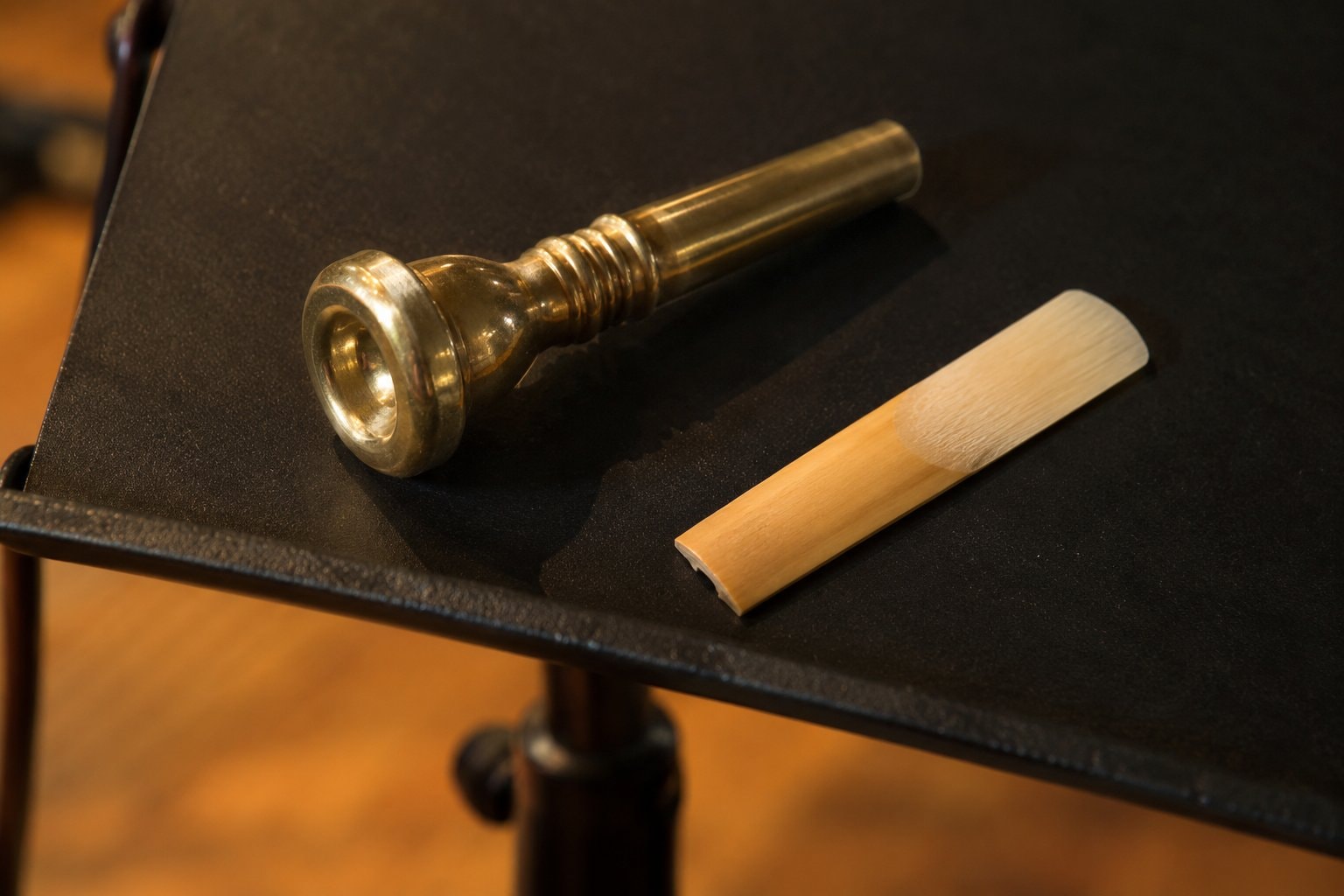
Wikipedia's embouchure article describes the lips, facial muscles, tongue and teeth involved in wind playing. Its saxophone article describes a reed vibrating on a mouthpiece; its trumpet article describes sound produced through the player's vibrating lips. These instrument descriptions distinguish the musical mechanisms that the embouchure literature examines.
Frucht's 2009 portrait reported on 89 musicians with embouchure dystonia. The report described typically painless symptoms triggered by specific playing techniques, with different patterns across brass and woodwind instruments. The portrait described persistent symptoms and disruption to working lives. Its scope is a portrait of those musicians, rather than a population prevalence survey.
Steinmetz and colleagues' 2014 survey concerned 585 professional orchestra brass players and reported self-described embouchure disorders, fatigue and cramping. It used a questionnaire and a cross-sectional design to examine associations. The authors said the findings might add insight into embouchure dystonia; the reported category of embouchure problems was broader than confirmed dystonia.
MedlinePlus's dystonia page describes involuntary muscular contractions, while Wikipedia's focal-dystonia article describes a condition affecting a particular body region during specific activities. Sussman's 2015 review describes musician's dystonia as task-specific, commonly affecting the embouchure or active fingers, with differences between instruments. It reports that painless, intermittent symptoms can be mistaken for overuse or tendon problems.
Hearing in musical work
The National Institute on Deafness and Other Communication Disorders, NIDCD, explains in its noise-induced hearing-loss account that loud sound can damage inner-ear sensory hair cells. Its account discusses intensity, exposure length and distance, and includes earplugs and reducing noise exposure in its public-health guidance. MedlinePlus's noise page also discusses damage to sensitive inner-ear structures. Wikipedia's noise-induced hearing-loss article places noise exposure in occupational and other settings.
MedlinePlus's general hearing page and hearing-loss encyclopedia entry distinguish problems involving the inner ear or auditory nerve from mechanical difficulties in the outer or middle ear. NIDCD's tinnitus account defines perceived sound without an external source, including ringing and buzzing. MedlinePlus's tinnitus page also describes clicking, hissing and other sounds; Wikipedia's tinnitus article describes tinnitus as a symptom with various possible causes.
Halevi-Katz and colleagues' 2015 study found relationships between amplified-music exposure, hearing thresholds and tinnitus among professional pop, rock and jazz musicians. They distinguished playing time from years of experience and called for a larger sample. Kähärit and colleagues' 2003 rock/jazz study used hearing tests and questionnaires, reporting hearing disorders under a broad definition including hearing loss, tinnitus and sound sensitivity. That category was wider than hearing loss alone.
In their 2013 study of college students, Gopal and colleagues reported equivalent continuous sound levels ranging from 95 dBA to 105.8 dBA during jazz instruction and temporary changes in auditory measures after exposure. The comparison involved ordinary classroom activity. Firle and Richter's 2025 scoping review found gaps in data on older and retired musicians, could not determine lifetime prevalence, and said no definitive prevalence assessment was possible from available data; representative longitudinal studies were needed.
Wikipedia's drum-kit history records the adoption of wire brushes because sticks could overpower other instruments. That history places sound balance beside the research questions about musical work. The musical side of the subject continues in swing, bebop, cool jazz and hard bop and in the careers of Bay Area jazz musicians.